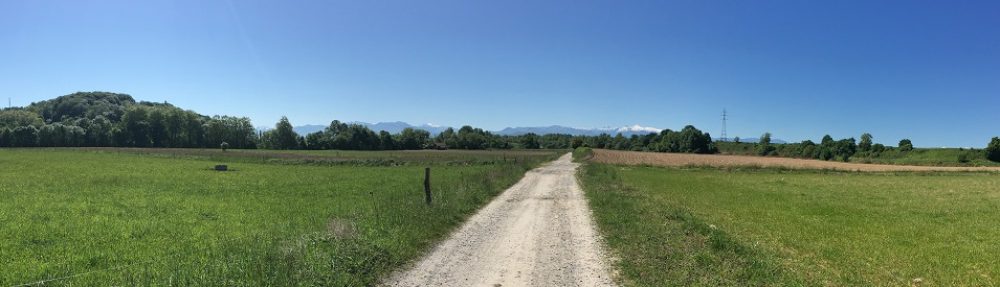
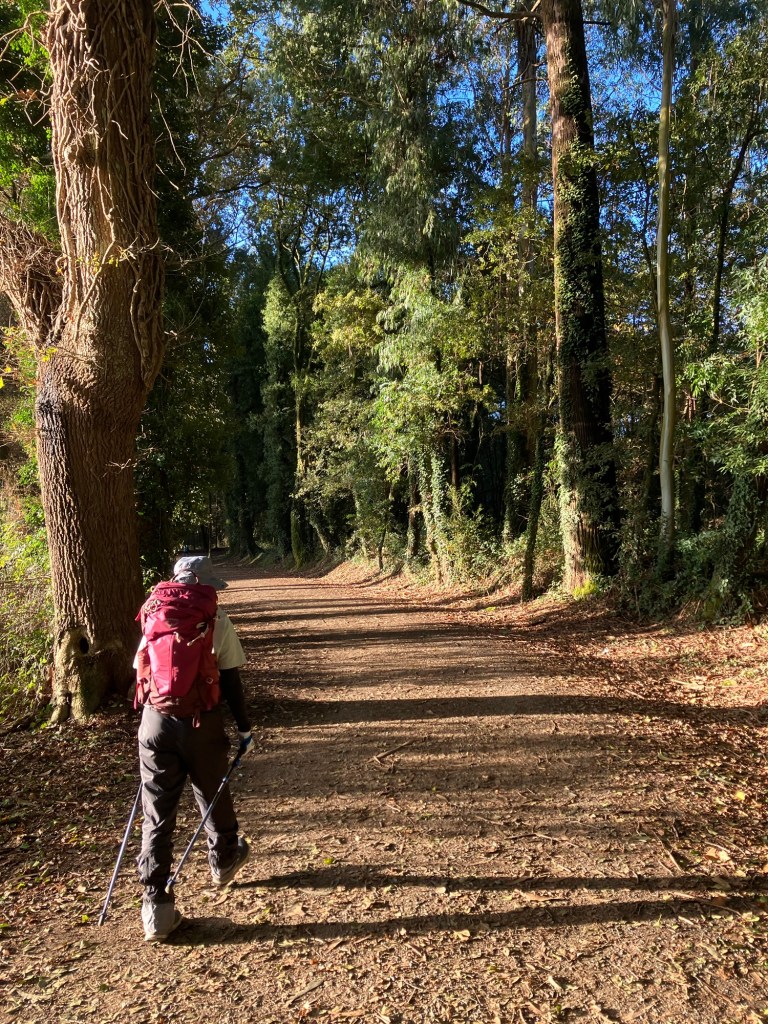
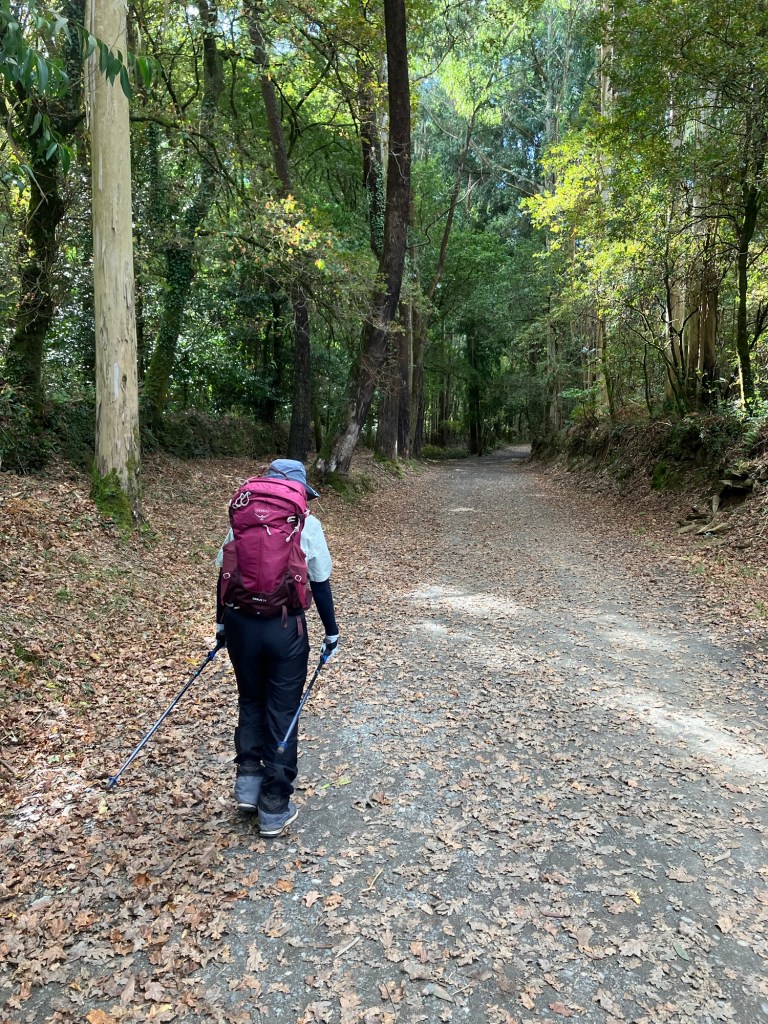
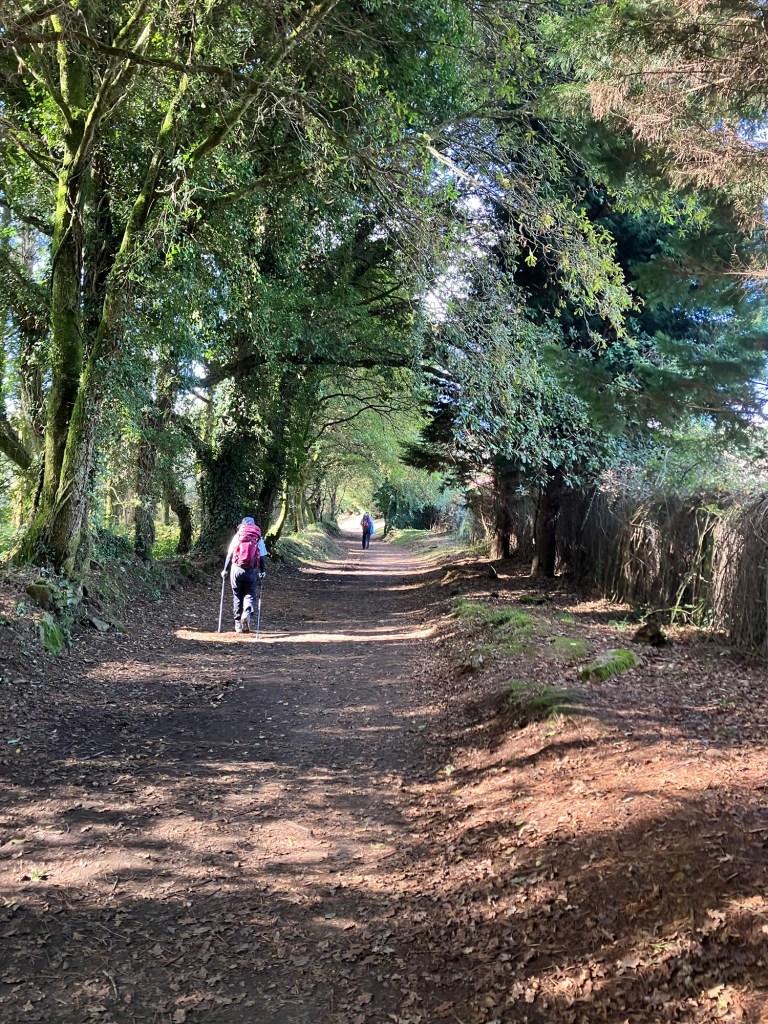
I probably should have just said one time that when we entered Galicia that all the trails in the province are best described as – the best parts are wide dirt tracks in the oak, chestnut, fir, or eucalyptus forests or on the hilltops with fantastic views and those portions make up about 50% of the trails. The tracks along the side of quiet roads are not bad and the trails next to busier roads are infrequent. There are lots of hills every day but they get easier every day until the last climb near the airport tomorrow. That really sums up the trails over the past several days tomorrow starts that way but the last 1/3 will be through the new and old parts of Santiago.
Other than the trail itself, we did see lots of farm animals today including chickens, lambs (which Melanie calls lamb chops), cows, horses, donkeys and mules. We also met a Hungarian man, introduced by our friend Hungarian Peter, who travels around Europe with his own donkey for 16 years, selling his book “My Donkey and me” and just enjoying a simple life. Melanie suggested to him that if the donkey isn’t already named, he should have the Spanish name, “Xote” (pronounced like ho-tay). She then conferred with the animal who seemed pleased to be know as “donkey Xote”, at least while he is Spain. (And that is a Nana joke for George)

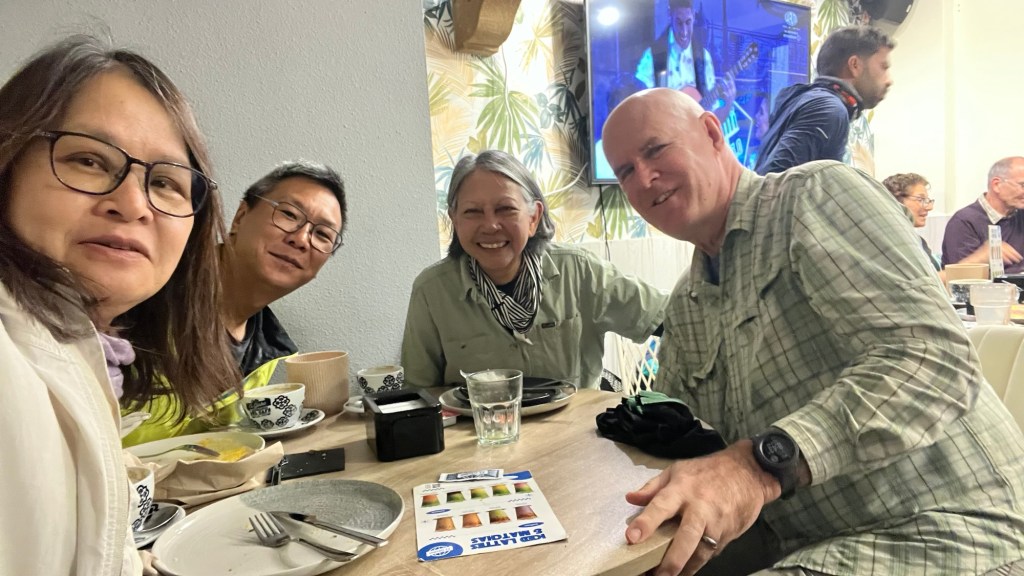
Breakfast #1 was in a small, crowded cafe in Arzúa and we were happy to have been invited to share a table with George and Estella from Hong Kong. Estella was the woman who had walking problems a few weeks back and Melanie walked with her until the medicine kicked in and she caught up to the waiting husband. We had a lovely conversation with them as well as the Spanish speaking family with two young kids at the next table who said they were from Canada. When we were ready to leave, the Canadians left just before us without carrying their dishes to the bar. Again, it’s not a Spanish custom to do that but most pilgrims do and the Canadians could have made it a teaching moment for their kids. Anyway, Melanie and I, as usual, started to carry their dishes to the bar for them. George also helped as well. Some other Canadians friends we have seen since Foncebadón witnessed this and said “you are very good pilgrims” which made me smile but when they said it to George, he replied “Melanie and Michael taught me”. That almost made me cry.
Later on the trail, we met the same group of Canadian friends on the trail and they said that they saw the Spanish speaking family a few hundred meters back. They said to the father “I hear you are from Canada” and the father confirmed that. Then they asked which city they lived in and the father replied “Tenerife”. Huh?!? I guess the difference between “Canada” and “Canarias” in Spanish isn’t as much as I would have thought. The family was from the Canary Islands, hence they are Spanish and it is not a Spanish custom to clear the plates. I never could figure out how someone who lived in Canada only spoke Spanish.

Later in the walk, Estella and Melanie were talking. Estella asked “Do you remember the day when I was hurting and you put your arm around my shoulder and asked to walk with me? The other day, I was walking slowly but I was about to pass a woman who looked in very bad shape. She was even slower than me. I remembered how your kindness helped me so I put my arm around her shoulders and told her I’d walk with her. When we arrived at the woman’s albergue, she asked if she could take a picture with me. The woman said she wanted to show it to her daughter and tell her ‘this is the Camino spirit’.” The moral of the story: There is always someone in need of help and you are always in a position to help someone in a worse position than you. Also, do good deeds. Someone out there is watching and learning.
Breakfast #2 was in a cafe in Calzada that had several vacant tables outside in the cold but very few spaces available inside. As soon as we walked in, the French couple Patrick & Cècile, said that they were finished and they were looking for pilgrims to give up their seats to. We qualified! We only had some juice and a slice of some delicious custard tart but, more importantly, we also had our toilet break. As we finished our snack, Melanie, once again, sprung into action to help clear two tables nearby where the pilgrims just left a lot of dishes and trash on the table. Just as Melanie was clearing the last plate, a Dutch woman walked back to her table in the corner and gasped “where is my tortilla? I hadn’t finished it yet.” Oops, the appreciative waitress pulled the tortilla out of the pile of plates and gave it back to the Dutch woman. The moral of this story: “you cruise, you loose.”

We met a Dutch man who was having significant difficulties. Our first sight of him was when he was standing bent at his waist and resting his head on the top of his trekking sticks. It turned out that he was doing that every 100m or so. Melanie, as usual, said we would walk with him a bit. He told us that he had started walking from his home, through Holland and Belgium. When he reached France, He realized that if he walked all the way across France, he would get to Santiago only at Christmas. Winter walking was not for him so he took a train to St Jean Pied de Port and walked from there. He looked to be in his 80s. We did walk a bit with him but he was slow and stopped often so eventually we left him. Later, we saw him in Empalme where we stopped for a salad. I hope that was his day finished there and that he was taking two more days to Santiago. Only Muslims believe that if you die during a pilgrimage, you automatically go to heaven. For Catholics, it’s a little more complicated.
One more day, but first I need sleep.
Peace y’all. Goodnight George, Leo and Stella. We love you all.
Just make us be brave and make us play nice
and let us be together tonight
~ still by Warren Zevon, still playing in my head


 Melanie & Michael Go Walking