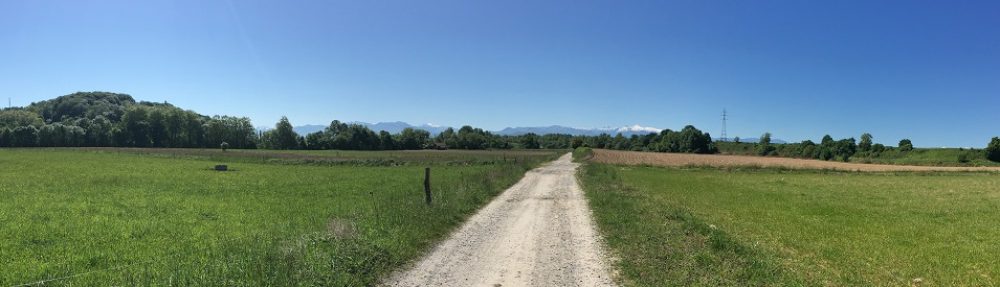
A crystal clear chilly day in rural Spain is a great recipe for a walk. Even a cold start in the dark was awesome as there was a cloudless sky. Between Hospital de Órbigo and the first town, Villares de Órbigo, we were in the middle of pitch dark farmlands and the field of stars (Campo estella or, Compostela!) was putting on a lovely show along with the thin crescent moon.
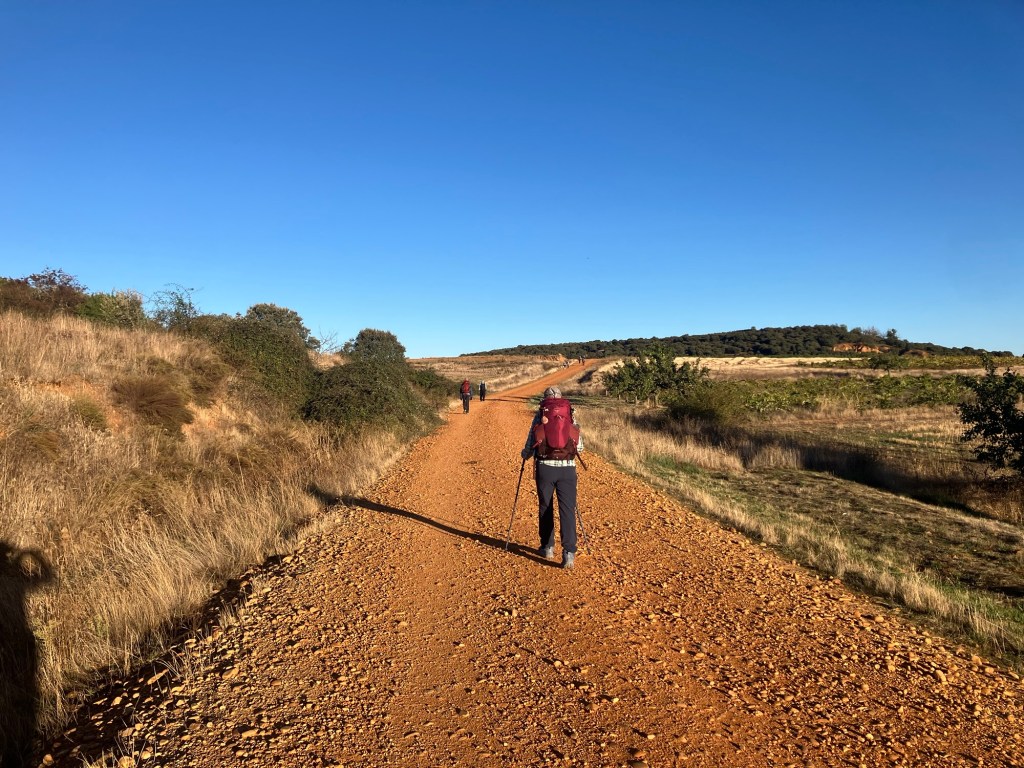
At an intersection near the end of the town of Hospital de Órbigo, there are arrows painted on the ground pointing in two directions. The first arrow points straight ahead and it said below the arrow that it is the “the road way”. The other arrow points to the right and below it it says “the Camino way”. The road route is the official trail but it’s just a lot more of walking along the same old N120 national road. The Camino Way route is obviously the preferred route of the sign painters and also Melanie and me. It might be a kilometer longer but it’s worth it. It also has more rocky trails and more hills but that just prepares us for the mountains ahead. We saw a pilgrim we know walk straight through that intersection without a glance at the options. He was too far ahead to call for at that hour of the morning and I wasn’t going to run after him with a backpack on either. Sorry dude.
At a cafe in Villares de Órbigo, we met a couple from South Carolina and also finally chatted with a young Italian woman who we have seen many times over the past few days. When we see her, she is either with a large group of friends or speeding past us on the trail. It turns out she now lives in Pisa but she knows very well several places along the Via Francigena route to Rome. She was very impressed that we have been to the completely not famous town of Vercelli twice and that we knew that our favorite mathematician, Fibonacci, was from Pisa. She was less than impressed that it took us a full minute to remember the name of the Provence of Tuscany.
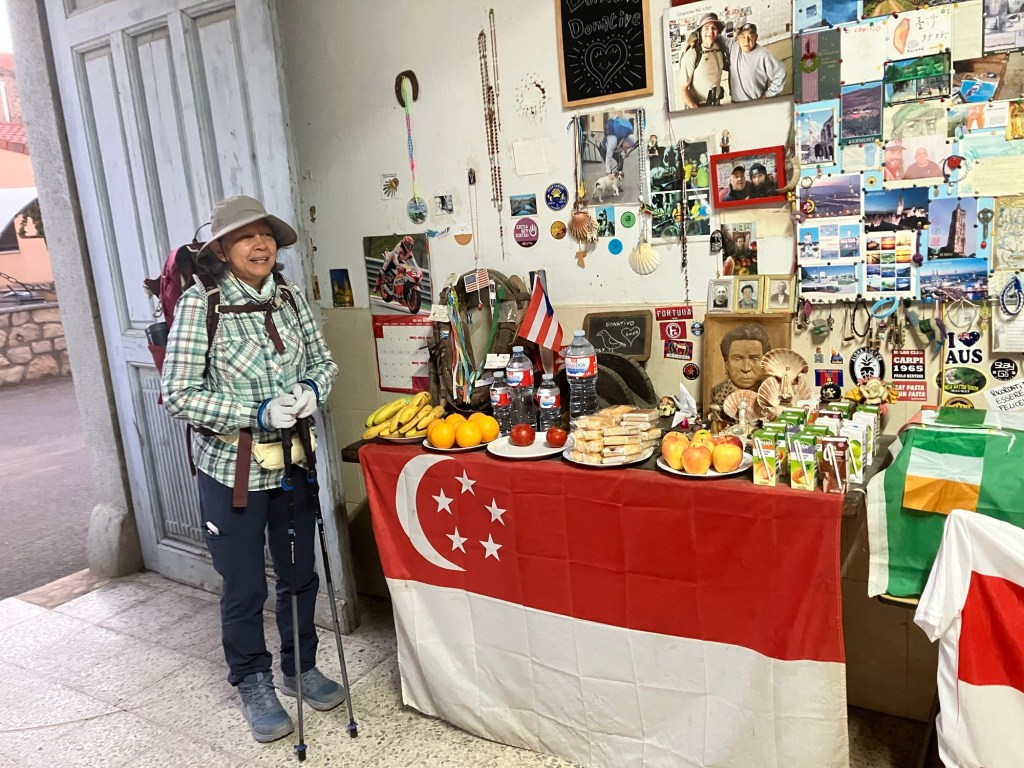
After breakfast, a few doors away, there is a Camino character. He stays in his open garage on the trail and invites pilgrims in to get a stamp for the Compostela. He has some trinkets for sale and some fruits, drinks and pastries for donations. One wall has pinned currencies from many countries around the world. It is the large flag of Singapore that he displays that brings us in though. We have to get Melanie’s regular photo with it. We asked him about it before but he always speaks with everyone as if they are fluent in Spanish. It’s still a mystery to us. I gave him €2 for stamping our credencials (and still displaying the flag) and he quickly insisting that we have a slice of what I believe was pie crust pie with sugar sprinkled on it. It was nice but definitely novel.
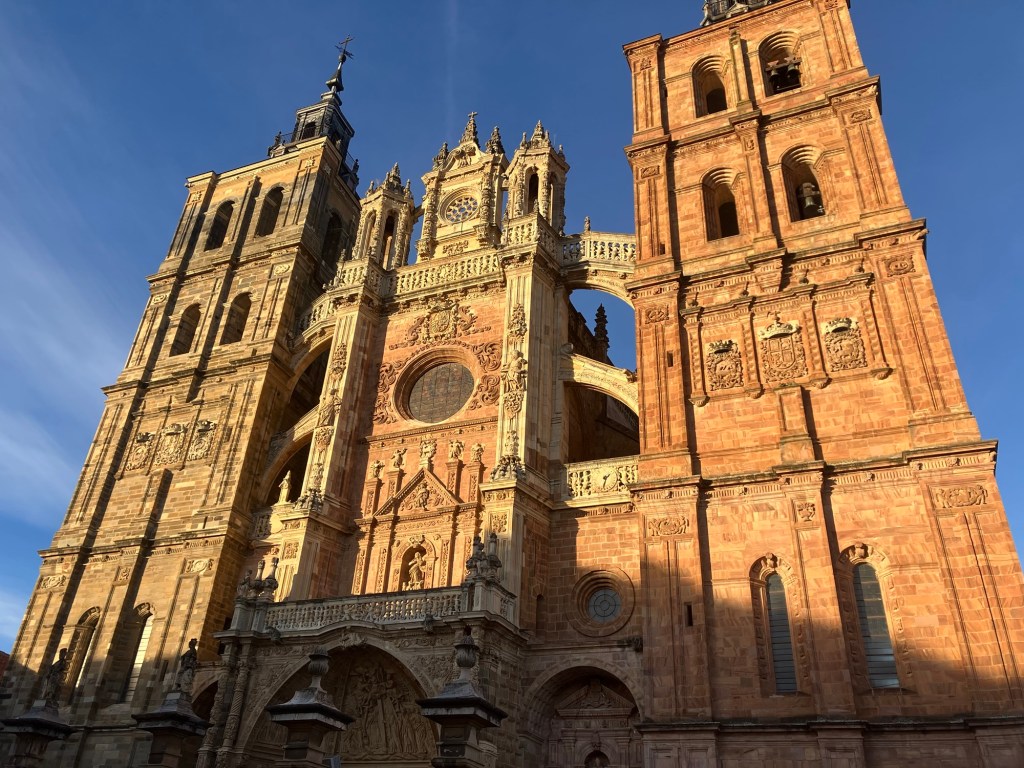
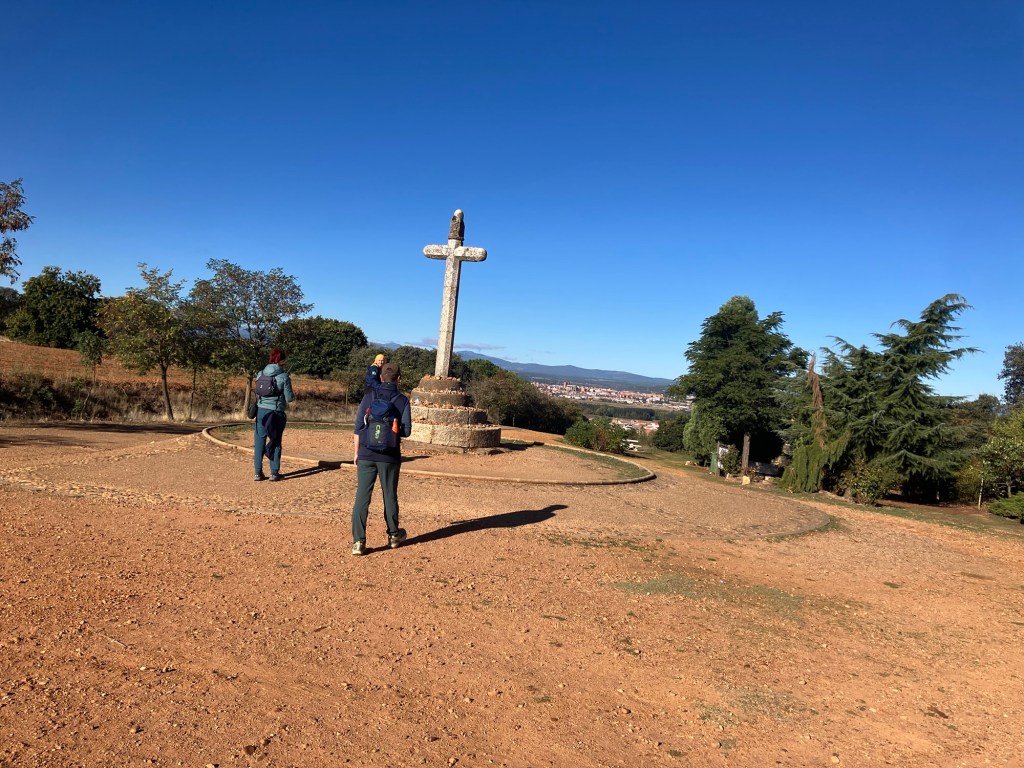
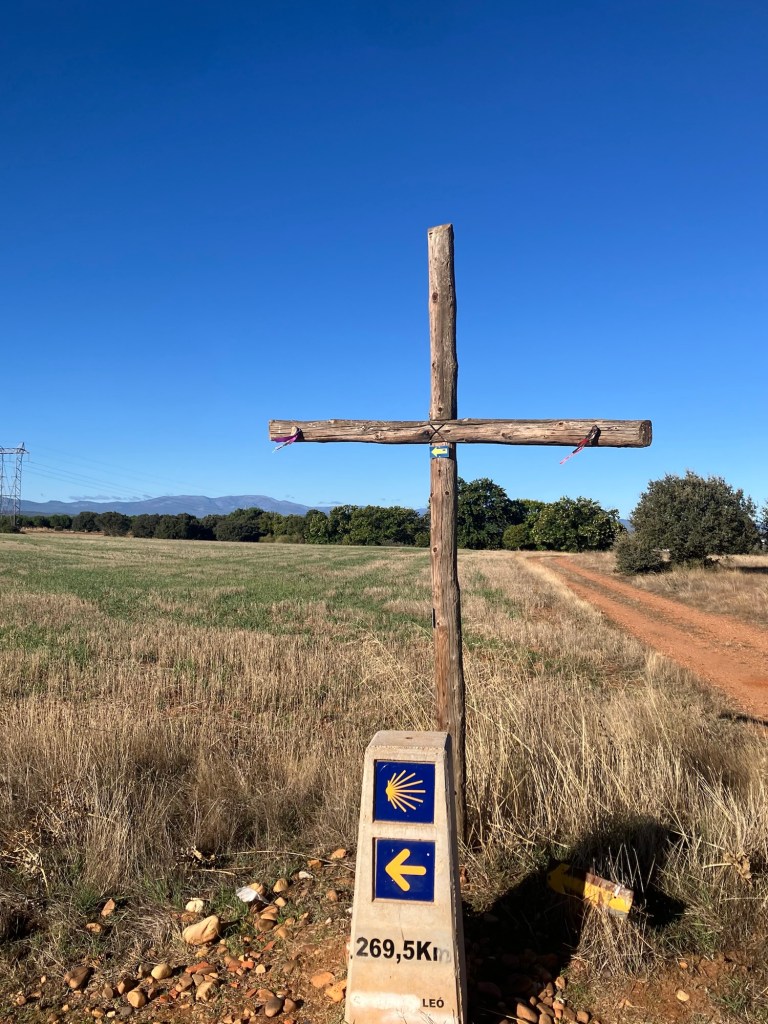
The highlight of the walk is seeing the whole city of Astorga from the last big hill we climb at the end of the Meseta. Behind Astorga are the mountains we will be crossing on our way to Galicia. On the day after tomorrow, we will also be walking through the pass where the famous Cruz de Ferro is (the iron cross). For practice today, we passed by the Cruz de Mármol (the marble cross), the Cruz de Madera (the wooden cross) and the Cruz de Concreta (the concrete cross)
There were no big scandals today but this is a message to the pilgrims that need to use the toilets in bars and cafes. Seriously, if you don’t want to buy anything to eat or drink, just walk up to the barman and hand him a euro. He’ll understand as you then run to the toilet. He will be fine with it. That’s why many places along the Camino have signs on the toilet doors saying that the toilets are for their customers, otherwise it cost a euro to use them.
While in a cafe outside of Astorga, where we were eating breakfast #2 1/2 (pie crust pie isn’t a full breakfast), we saw a young Canadian couple looking in the window. The guy took off his backpack, put down his hat and walking sticks and then watched for when the barman turned his back. He then came in with his head down and walked straight to the bathroom. A moment later, he came out walking quickly to the exit. Five minutes later, the girl did the exact same procedure. It reflects poorly on all pilgrims. That’s why I went up to the barman as the couple walked away, gave him €2 and said “todos no somos así” (we’re not all like that). You two owe me.
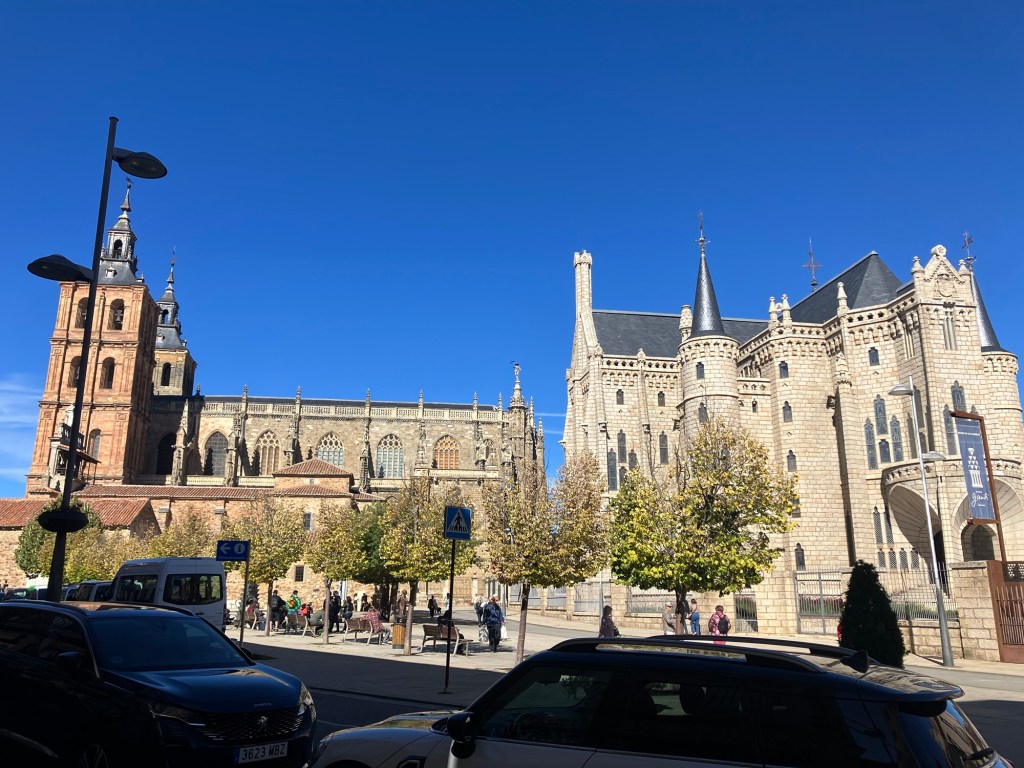
Three cheers to the people of Astorga. They have compromised on dinner time. Many of the smaller towns and cities, if they have restaurants, they usually open at 9:00pm for dinner. Astorga’s many restaurants now open at 8:00pm for dinner to accommodate pilgrims and the many tourist who like to eat at 6:00pm. A special shout out to one restaurant, Diferent Astorga Restaurant. We started looking for any dinner at 6:00pm. At 6:40pm, we found Diferent taste who, according to a sign on the door, opens at 7:00pm. Yeah! We spent the next 19 minutes drooling over their menu del día options on the signboard outside. At the stroke of 7:00pm, several people and I wrestled our way in through the front door, only to be told that the bar is open at 7:00pm, the kitchen opens at 8:00pm. We walked around for yet another hour looking for any food. When it was obvious all of the 412 restaurants in town open their kitchens at 8:00pm, we went back to Diferent Astorga to have a drink the order the menu del día when permitted. Guess what? After relaxing with a drink, we read the fine print on the menu. There is no menu del día on evenings, weekends, local festival days, national holidays or days ending 8n the letter “y”. We could not order any of the food that we were craving from the other menu. Buggers.
That’s enough whinging for the day. Peace y’all.
Goodnight Stella, Leo and George. When will you come to to Spain with Gramps & Nana?